Before Michael Jackson, pop stardom had a ceiling. After him, there wasn’t one anymore. He didn’t just have hits he changed what a hit was supposed to look like, sound like, and cost to make.
From Child Star to Architect
Jackson arrived with the Jackson 5 as Motown’s most polished export, but the adult reinvention was the real revolution. Teaming with producer Quincy Jones on Off the Wall (1979), he fused disco, funk, jazz chords, and orchestral pop into something that could fill a dance floor and a listening room at once. It was the blueprint. Then Thriller (1982) took that blueprint and burned the building down — seven top-ten singles from one album, a record that still trades places at the top of the “biggest ever” list.
The Video Era Begins
Here’s the pivot most people underestimate: Jackson turned the music video from a promotional afterthought into an art form and an event. “Billie Jean” helped crack MTV’s reluctance to play Black artists in heavy rotation. “Beat It” brought Eddie Van Halen’s guitar solo into a pop song and onto the channel anyway. And “Thriller” — a 14-minute short film directed by John Landis — made videos into tentpole releases that the whole world watched like TV premieres. Every artist who followed, from Madonna to Beyoncé to Taylor Swift, has been playing in a field he plowed.
Sound, Rhythm, Voice
Musically, his fingerprints are everywhere. The percussive vocal hiccup, the gasp used as an instrument, the beatboxing and tongue-clicks layered into tracks like “Wanna Be Startin’ Somethin’” producers still steal this vocabulary wholesale. “Beat It” normalized the rock-and-R&B crossover as a pop default. “Wanna Be Startin’ Somethin’” traveled decades forward through sampling, most famously powering Rihanna’s “Don’t Stop the Music.” You can draw a direct line from his rhythm tracks to Bruno Mars, The Weeknd, and virtually every choreographed pop act working today.
Television and Spectacle
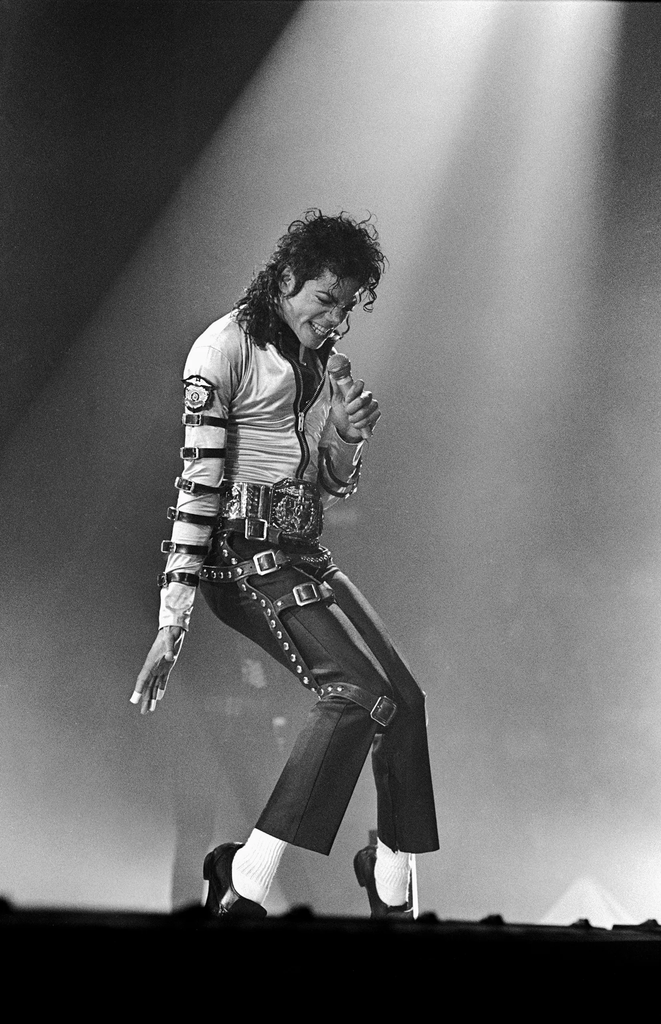
Jackson also redefined the live performance as must-see television. His Motown 25 moonwalk in 1983 turned a single step into the most famous move in pop history. Super Bowl halftime shows became blockbuster spectacles because of him, and the military-jacket-and-single-glove imagery proved that a pop star could be recognized by silhouette alone — branding before anyone called it that.
Breaking Barriers
None of this happened outside race. A Black artist becoming the first true global superstar, the first video rotation breakthrough on MTV, the first name on everyone’s lips from Lagos to Tokyo, widened doors that had been welded shut. Artists of color who came after inherited space he forced open, whether or not they cite him.
The Complicated Legacy
Any honest account has to hold two things at once: the music reshaped everything, and the later years the tabloid transformation, the two trials, the allegations he denied until his death in 2009 he had made his inheritance harder to claim cleanly. That tension is part of his story now, the way it is for many giants. Streams and tribute covers suggest the art keeps outliving the argument.
The Bottom Line
Michael Jackson’s influence isn’t a genre you can point to; it’s the default settings of modern pop. Blockbuster albums, cinematic videos, cross-genre collisions, choreography as a headline
skill, the superstar as global brand although he didn’t invent all of those alone, but he proved all of them were possible, simultaneously, at a scale nobody has matched since. Pop after him is just
different math.